


Brussels could easily have treated Grand Place like a museum piece. Guildhalls line its edges, ornate facades command attention, and centuries of civic history are packed into a relatively compact space.
City life, however, refuses to keep it quiet.
Few public spaces can switch identities so convincingly without losing their sense of place.
For one month, Grand Place feels like an open-air concert hall.
A few weeks later, it can resemble a Renaissance court. By December, stone facades become part of a giant seasonal light show.
So what actually happens here over the course of a year?
Winter Wonders Turns Grand Place Into a Christmas Stage

Winter Wonders transforms central Brussels during the Christmas season, with Grand Place acting as one of its visual anchors.
For visitors planning to stay close to the celebrations, La Bourse Hotel, steps from the Grand Place, puts the square, Christmas-market areas, and central Brussels within easy walking distance.
A large Christmas tree rises in the square, a nativity scene joins the seasonal display, and surrounding facades become part of carefully timed light-and-sound presentations.
Daytime gives visitors one version of the setting. Darkness brings another.
Once evening arrives, architectural details become surfaces for light, music fills the square, and coordinated displays draw crowds toward the center.
Buildings that normally command attention through stonework and ornament suddenly participate in a moving audiovisual production.
Christmas tree proportions make sense here because the surrounding buildings are so tall and elaborate. Smaller decorations might disappear against the architecture. Large-scale installations can hold their own.
Brussels Jazz Weekend Turns Historic Brussels Into a Concert Venue
Brussels Jazz Weekend usually arrives in May, bringing free performances to locations across central Brussels.
Grand Place becomes one of its most striking settings, with live musicians playing against rows of decorated guildhall facades.
Architecture could hardly provide a more dramatic backdrop.
Brass instruments, drums, keyboards, and amplified performances occupy a square better known for Gothic and Baroque details. Instead of clashing, those two worlds work surprisingly well together.
Free admission also changes the atmosphere. People do not necessarily arrive dressed for a formal concert or holding expensive tickets.
Some come specifically for jazz. Others encounter the music while walking through central Brussels and decide to stay.
Crowds gather around temporary stages, nearby terraces fill up, and music carries across the paving stones.
Festival programming can include established performers alongside emerging artists, giving listeners a chance to hear several styles over one weekend.
Grand Place consequently feels less like something visitors observe and more like somewhere people actively use.
Ommegang Sends Grand Place Back to the 16th Century
Jazz barely has time to fade before Brussels begins preparing for something much older.
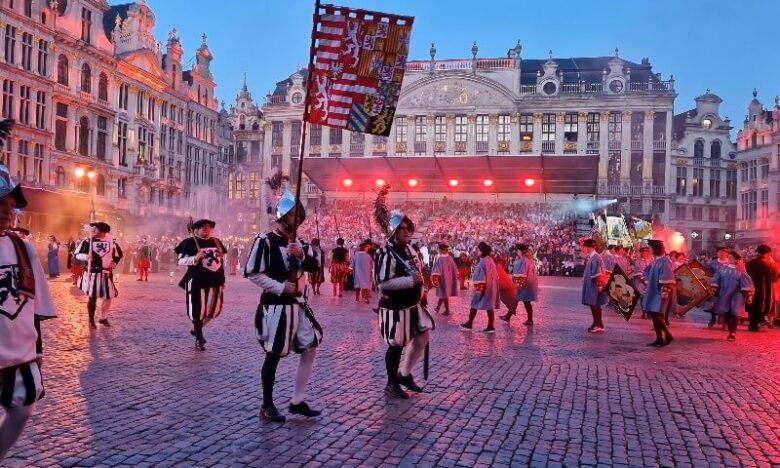
Ommegang reaches into one of the city’s most theatrical episodes.
Festivities are linked to Emperor Charles V and his 1549 visit to Brussels, with modern performances recreating the pageantry associated with that period.
Costumes do much of the visual heavy lifting.
Participants appear as nobles, soldiers, guild members, officials, mounted figures, and other characters connected to 16th-century civic life. Horses enter the spectacle, banners move through the crowd, and elaborate clothing replaces everyday city wear.
Grand Place becomes unusually convincing as a setting for it all. Modern infrastructure is still there, naturally, but ornate historic buildings surrounding the square reduce the amount of imagination required.
Processions and staged scenes build a sense of ceremony rather than simply creating a costume parade.
One person wearing Renaissance clothing might look like a reenactor. Hundreds of participants moving through central Brussels create something closer to a temporary historical world.
The Flower Carpet Covers the Square With a Short-Lived Work of Art
View this post on Instagram
August can bring Grand Place its most photographed transformation, although visitors need to check the year before planning a trip around it.
Flower Carpet takes place every two years, traditionally in even-numbered years. Instead of decorating only the edges of the square, organizers use its central surface as an enormous canvas.
Hundreds of thousands of flowers and floral materials are arranged into a carefully planned design covering a large section of Grand Place.
Patterns change with each edition, giving every installation its own theme and visual identity.
Looking across the installation beside the flowers reveals texture and individual sections of color. Seeing it above street level makes the full geometry much easier to grasp.
Balconies and elevated viewing areas are therefore especially popular during the event.
Once dismantling begins, an enormous artwork that took careful planning and coordinated installation simply disappears.
Belgian Beer Weekend Brings Brewing Culture Into the Heart of Brussels

September shifts attention away from flowers and toward another Belgian institution.
Belgian Beer Weekend brings breweries, tastings, ceremonies, and beer enjoyers into central Brussels, with Grand Place providing a particularly fitting setting.
Brewing has long been tied to Belgian commercial and guild traditions, and the square’s historic associations with brewers give the event an added sense of continuity. Beer here is not treated only as a drink sold at temporary stands.
Brewing culture, producer identity, ceremony, and regional traditions all become part of the weekend.
Visitors can encounter beers produced by established names as well as smaller breweries. Styles vary considerably, giving participants opportunities to try products connected to different parts of Belgium.
Tasting is only part of what happens.
Ceremonial elements and organized events bring a more formal tone to portions of the weekend.
FAQs
Closing Thoughts
Grand Place could survive perfectly well as a beautiful square people visit once, photograph, and check off an itinerary.
Brussels asks more of it.
Centuries-old buildings become scenery without becoming static scenery. Visitors gather there for reasons that change month by month, sometimes for music, sometimes for flowers, sometimes for beer, sometimes simply to watch Grand Place light up on a winter night.
Brussels has found a clever way to keep one of its oldest public spaces busy.
Same square. Completely different evening.
 Nina Smith
  Kim Marks